




The Earthquake Research Affiliates (ERA) is a partnership that has been in existence for over 50 years. The ERA program brings together leaders in business, academia, and government to address questions about risk assessment and reduction, emergency response, and planning and preparation for significant earthquakes. |
 |
||||||||
|
|
|
|
|
|
|||
************************
************************ M5.1 Hector Mine aftershock occurred at 8:18pm on 12/05/08, located 16 miles WNW of Ludlow, CA, and was felt over a wide area of Southern California. The event was followed by 45 smaller aftershocks, the largest being a M3.5 at 15:39 on 12/07/08. So far, there have been 34 events M2.0 and greater, and 4 events M 3.0 and greater (including the mainshock).
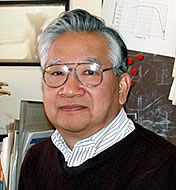
Hiroo Kanamori Recipient of the Kyoto Prize Caltech Media Center Opens
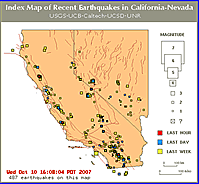
To learn about how we collect data on seismological activity in Southern California, please visit www.SCSN.org. The Southern California Seismic Network (SCSN) is a branch of the California Integrated Seismic Network (CISN) and is made up of more than 350 seismic stations, creating one of the densest seismic networks in the world. Sign up for ShakeMovie and Alerts at: http://www.shakemovie.caltech.edu/signup | Recent Earthquakes: Earthquakes of the Last Week: http://www.scsn.org Today in Earthquake History: To recieve Earthquake Notification by email visit: Did You Feel It? Community Internet Intensity Maps- Register your experience!
Earthquake professionals, business and community leaders, emergency managers, and others have joined together to organise Dare to Prepare, a year-long earthquake readiness campaign to raise earthquake awareness and encourage earthquake readiness in Southern California. Acknowledging that "Shift Happens," the main message of the Dare to Prepare campaign is that if you "Secure Your Space" you can protect yourself, your family, and your property. Secure your space by strapping top-heavy furniture and appliances to walls, adding latches to kitchen cabinets, and securing TVs and other heavy objects that can topple and break or cause serious injuries. These and other simple actions will greatly reduce your risk of damage or injury, and limit your need for community resources after the next earthquake. Visit the Dare to Prepare site or order a "Putting Down Roots in Earthquake Country" booklet and dare to prepare yourself for the next big one! ShakeMap:
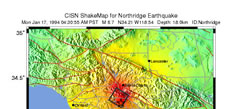
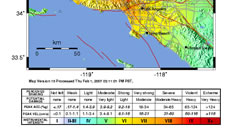
ShakeMap is a tool used to portray the extent of potentially damaging shaking following an earthquake. It can be used for emergency response, loss estimation, and public information. Caltech Seismo Lab The Earthquake Research Affiliates office works closely with the Seismology Lab Department at Caltech. Please visit the Seismo Lab site for more info on the people, research, and technology that make Caltech a leader in earthquake research!
|
|||||||